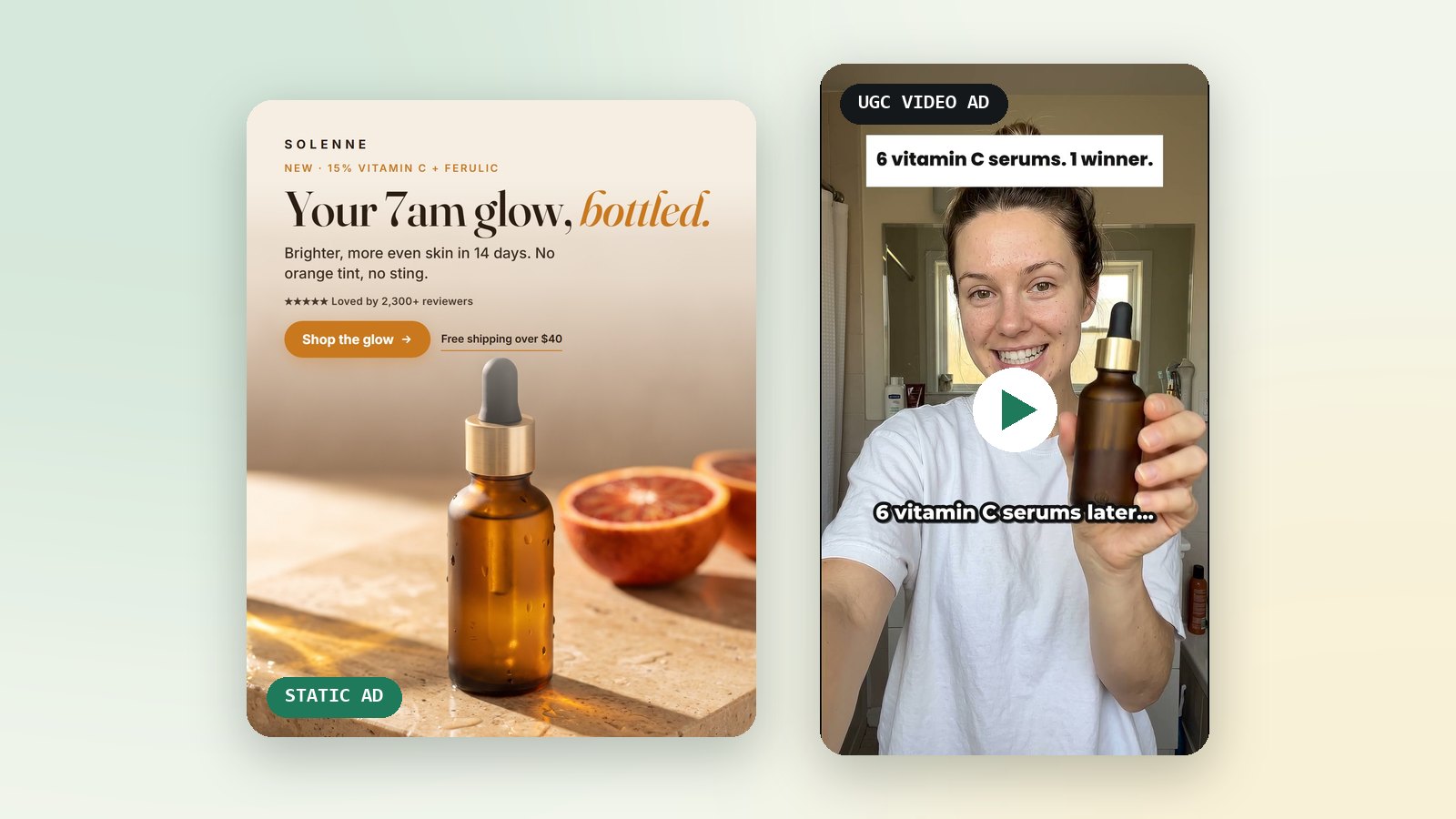
Almost every brand I work with asks the same question before a launch: should we run static ads or video? It sounds like a format question. It is really a question about what the ad has to do. Some ads need to explain an offer in one second. Others need to make a stranger believe a product works. Those are two different jobs, and they need two different creatives.
I build both for e-commerce, fitness and med spa brands. Here is how I think about each one, and how I get them working together instead of competing for the same budget.
What static ads do best
A static ad wins when the message is simple and the viewer only needs one look to get it.
- They make the offer instant. A price, a bundle, a free shipping line or a before-and-after reads in under a second. There is no waiting for the good part.
- They are fast to test. I can write five headlines for the same product photo in an afternoon and learn which angle the audience cares about, before I spend anything on video.
- They carry retargeting. Someone who already watched a video or visited the site does not need the story again. They need the offer, a reason to come back, and one clear button.
What UGC ads do best
UGC, short for user-generated content, is a person talking to the camera like a friend would. It wins when the viewer has a doubt the product has to answer.
- They build trust. A real face, a real bathroom, a real kitchen. It feels like a recommendation, not an advert, so people give it more attention and more benefit of the doubt.
- They show the product working. Texture, size, how it fits into a morning. A demo answers objections a headline cannot.
- They handle the skeptic. "I didn't think this would work" is one of the strongest openers in paid social, because it speaks for the viewer who is thinking exactly that.
Static ads sell the offer. UGC sells the trust. Most campaigns need both: UGC to introduce the product, static to close the sale.
How I build a static ad that stops the scroll
1. One message per ad
If a static ad says three things, it says nothing. I pick the single strongest reason to buy, the offer or the outcome, and make everything else support it.
2. The product is the hero
The product should be big, sharp and lit like it costs what it costs. I leave clean space for the headline so the text never fights the photo.
3. Short headline, visible offer
A short headline, one line of support, and the offer on the image itself. People scroll with their thumb, not their reading glasses.
4. Built for the placement
I design at 4:5 for the feed and 9:16 for Stories and Reels, and I keep text out of the top and bottom edges where the app's buttons sit.
How I build a UGC ad that converts
1. The first two seconds are the ad
The hook decides whether anyone sees the rest. I use one of three openers: a problem the viewer has, a result they want, or a pattern break that makes them look twice.
2. Demo, proof, then the ask
After the hook, the creator shows the product doing its job, says why it worked for them, and closes with a clear call to action and an end card. Ten to fifteen seconds is usually enough.
3. Captions are not optional
Most people watch with the sound off. I burn captions in and keep the key words big, so the ad still sells on mute.
4. One body, several hooks
I cut the same video with two or three different openings. The body stays the same, so when one version wins, I know it was the hook and not something else.
How I test static against UGC
The fairest test changes one thing at a time. I keep the offer, the audience and the landing page the same, and let the creative be the only difference.
- Give each ad enough spend to speak. I do not judge an ad on its first day or its first handful of clicks.
- Judge on the number that pays the bills. Cost per purchase or cost per qualified lead, not just click-through rate. A cheap click from the wrong person is not a win.
- Read the video metrics too. How many people stop on the first frames, and how many stay to the end, tell me whether to fix the hook or the body.
- Pair the winners. The best setups I run use UGC to introduce the product and statics to retarget the people who showed interest.
Where AI fits in
AI image and video tools let me produce product shots and UGC-style concepts quickly, so I can test more angles before a brand commits to a full shoot. The tools make the raw footage. The parts that actually sell, the offer, the hook, the copy, the edit and the testing plan, are still the work. You can see examples on my static and UGC ad samples page.
The shorter version
Do not ask whether static or video is better. Ask what the ad has to do. If the viewer needs to understand the offer, run a static. If they need to believe the product works, run UGC. Then test both on the same offer, judge them on real results, and let each one do the job it is best at.